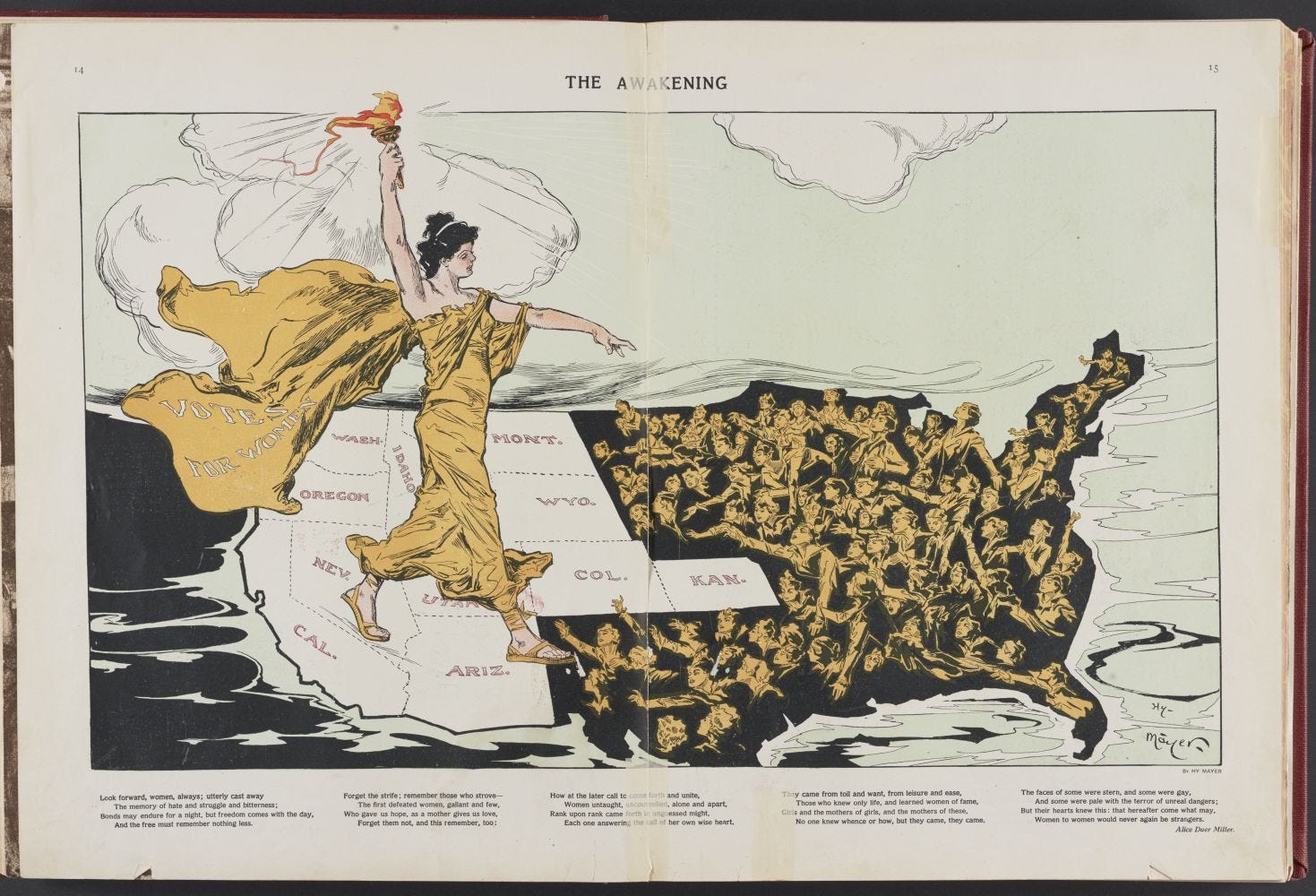
It was one of those American history facts that stuck with me:
State- or territory-wise, women first got the vote in Wyoming, way back in 1869, a full half-century before the 19th Amendment was ratified. So I always had a fond spot for Wyoming, even before I visited Yellowstone and the Tetons.
Mandatory acknowledgment:
If the centennial of the 19th Amendment a few years ago taught us anything, it was that the Amendment and the movement that produced it only worked for some women, not all women. For instance, Native Americans were not considered U.S. citizens until 1924, and it took several more decades to fight state “standards” that continued to restrict their voting rights. Similarly, it took almost 50 years after ratification before the passage of the Voting Rights Act gave black Americans some measure of guarantee and protection of their votes and their right to vote.
Unfortunately, I can’t even use “but I digress” here … because we’re all about digression in the US of A; one step forward, two steps back, then another step forward, then … avoidance?
Or, so many asterisks that illustrate our continuing struggle for our “more perfect union.” Still, we try to rise and move ahead.
Wyoming, and America, meet New Jersey
I’ve learned a lot since I first learned that opening factoid about Wyoming and women.
Another asterisk demanded I dive into the New Jersey headache of women getting the vote (1790), then having the vote taken away from them (1807) in New Jersey, then more than a 100-year delay for the (almost) real thing (for some of us), in an example that perfectly sets up the sparking tension that still exists between state and federal jurisdiction and control. (If you thought the Civil War settled that tug of war, wake up and smell the bear spray.)
Of course, given the history some would have us not know or learn, the New Jersey saga also is a stew of patriarchy and property, with a familiar topping of “fooled you!” -- see yesterday’s Roe v. Wade, and the would-be U.S. Supreme Court justices who swore Roe was “settled” law as they were trying to get the job and then re-settled it into past tense once they were robed … and we were robbed.
Which does bring me, finally, back to Wyoming, whose state motto remains, unironically, “Equal Rights.”
The abortion exclamation point
The first state to give women the right to vote also, last week, became the first state to explicitly ban abortion pills in the post-Roe world American women and families now live in. And maybe die in.
The Wyoming law that kicks in July 1 is like the exclamation point for prescription-only medications that enable abortions, the first law in the country to specifically call out an abortion drug for criminalization, complete with jail time and fines for those who provide or “procure” it. This law is in addition to a newly enacted ban on any type of abortion under all but the most restrictive of circumstances in that state.
More than half the abortions in the United States are medication abortions, which use two drugs for the surgery-free process.
So … bet you already guessed it.
In addition to the new law(s) in Wyoming, a Trump-appointed federal judge in Amarillo, Texas, is weighing a lawsuit brought by anti-abortionists who seek to topple the legality of mifepristone, one of the drugs used in medication abortion and the one targeted in Wyoming.
FDA un-approval?
The drug has been available for abortions with FDA approval in the U.S. for more than 20 years, and a ruling against that FDA approval would put medication abortion out of reach for tens of millions of American women.
What does all this have to do with Wyoming’s place in the pantheon of women’s enfranchisement?
Peel the onion just a little and another asterisk falls out.
Undoubtedly, there were more than a few good men who supported woman’s suffrage in 19th century Wyoming for legit reasons of fairness and equality.
But it is also true that this was a bit of a gambit as a means to an end: to draw women— and child-bearers -- to the West, specifically Wyoming. At the time voting was approved, there were 6,000 men in Wyoming and only 1,000 women. They needed numbers for all sorts of reasons, including territory-hood and later statehood. They thought women would boost that score.
The idea bore fruit (and kids) for Wyoming, if not exactly for women.
How go the votes and equality?
If Wyoming was first with the unrevoked vote for women, they’re hugging the bottom for percentage of women who serve as elected state officials – third worst in the country with 22.2 percent. This, despite the fact women make up almost half of the potential voters in Wyoming, just a touch below 50 percent. Not only that, they booted Liz Cheney, their only congressional representative, from her seat after her distinguished duty on the House Select Committee to Investigate the Jan. 6 Attack on the U.S. Capitol. Sisterhood, eh?
Other Western states which were early supporters of woman’s suffrage – among them, Colorado, Arizona, Oregon, Washington -- have fared better with women in representative government. Nevada leads the way with 60.3 percent, with the other mentioned states well above 40 percent representation in state legislatures.
Not coincidentally, many of the states with good representation of women in state assemblies also make up the dozen that have banded together to keep mifepristone FDA-approved.
So, women and voting.
Some questions. Your answers?
How much convincing do we need that women, and our futures, are our own special interest?
That we need to vote as if our lives depend on it, because they do.
That we appreciate them but we can’t count on a few good men or allies to do the heavy lifting of bringing a better, safer, healthier, more equitable tomorrow to those who will follow us, because that’s up to us, right now.
That we need to come together, as women, as voters, on opposing these measures, and the politicians who push them, because they not only don’t serve our interests but they endanger our lives.
That our votes are our voices and our voices and our votes should be demanding freedom and equality, just as our founding documents promised, and we can’t be equal if we are not free agents of our own futures.
Wouldn’t it be something if more women in Wyoming decided to vote their interests because their elected officials are not?
Wouldn’t it be something if the women who still allow their state to call itself the state of Equal Rights actually worked to put meaning back into that motto?
Wouldn’t it be something if American women did the same for their country and themselves?
V O Y A G E is a reader-supported publication. To receive new posts and support my work, consider becoming a free or paid subscriber.